In detail
Project snapshot
Project: North Coast Pontifex, North Coast Medical internal tooling
Role: Full-stack design engineer
Stack: Next.js, React, TypeScript, Convex, Microsoft Entra ID, OpenAI Responses API, Retool webhooks, Tailwind CSS, Cloudflare Worker branded links.
Problem
Sales and account teams relied on fragmented workflows involving pasted mNotes, product meta IDs, distributor context, samples, account activity, and follow-ups. They needed polished outputs with human review, secure access, external sharing, and continued Retool integration.
Approach
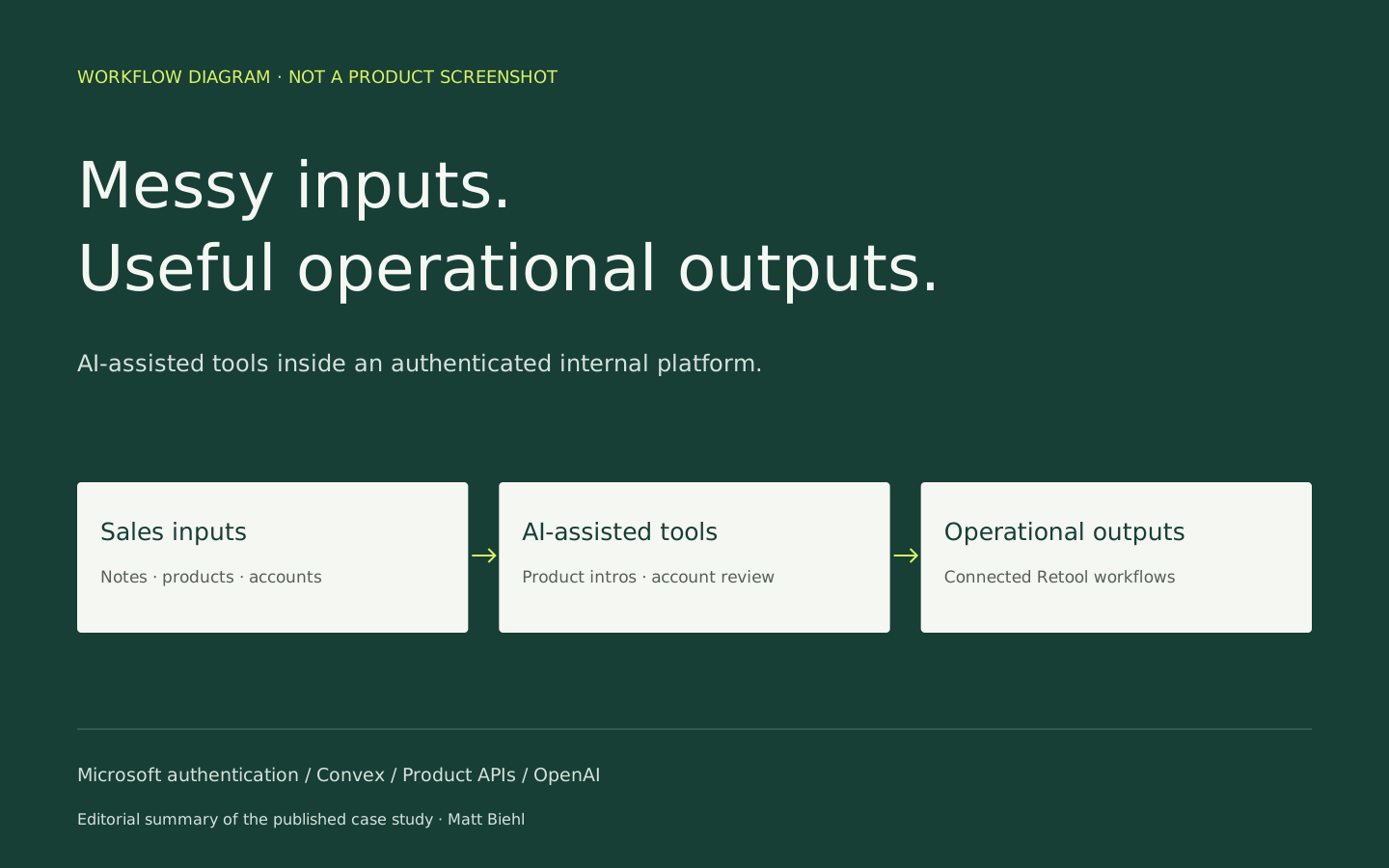
I designed and built the platform across product, frontend, backend, auth, data modeling, and integrations. Structured imports, previews, manual selection, editable documents, image controls, and draft recovery make AI outputs inspectable rather than opaque. A shared shell, tool registry, access model, data layer, and webhook boundary support multiple tools.
Implementation
- The Product Intro Generator parses mNotes category headings and product IDs, fetches product API metadata, optionally analyzes a company homepage, and generates structured introduction copy.
- Users review parsed products, add products through search, choose images, reorder/refine sections, save drafts, and share read-only documents.
- Generation is grounded in selected products, API data, optional company context, and cached summaries. Thin context produces neutral copy. Guardrails prohibit invented claims, partnerships, pricing, availability, and internal-process references.
- Structured fields preserve relationships; server sanitization removes common internal-language leaks. Product summaries cache by metaItemId, company profiles by normalized website URL.
- Migrated state from PocketBase to Convex. Added Entra sign-in, Convex custom OIDC, whitelist seeding, per-user tool gates, admin access, auth recovery, redirects, and collaborator controls.
- Public read-only documents use /plg-document/[id], branded Worker links, public asset allowlisting, route restrictions, and sample request routes.
- Retool webhooks support account search, mNotes, accounts, normalized summaries, and debug/testing flows.
- Started Account Activity Review with account filters, sample flags, request/search timelines, and review layout.
- Tests cover access, documents, parsing, samples, Retool integration, and tool manifests.
Outcomes and limitations
Delivered a repeatable guided sales-support workflow, draft recovery, branded sharing, and reusable infrastructure for internal tools. Caching reduces repeated AI work and supports consistency. Account Activity Review was started—not described as completed. Messy notes, partial data, AI guardrails, public sharing, cross-system authentication, and legacy Retool dependencies remain constraints; no quantitative business results are provided.
Adapted from portfolio text; images and navigation omitted.