In detail
Project snapshot
Client: North Coast Medical
Role: Full-stack design engineer
Stack: PHP, WordPress, custom ecommerce, legacy API, MySQL/MariaDB, JavaScript, Stripe, Cloudflare Turnstile, Plausible, Retool, Holistics, SalesLoft.
Problem
The production platform combined WordPress, a bespoke ncmecom storefront, a legacy API, Stripe checkout, RX Cart practitioner-to-patient ordering, and account-specific pricing and billing. Modernization had to preserve live ordering while clarifying identity, permissions, checkout state, medical-account constraints, attribution, and reporting.
Approach
I traced behavior through sessions, account state, API calls, database rows, and third-party services before changing interfaces. Rather than rewriting the platform, I isolated risky state, preserved existing paths, introduced explicit rules and traceability, and created operational documentation.
Implementation
- Improved RX Cart bundle creation and editing, starter/account bundles, product-option selection, mobile navigation, QR distribution, patient presentation, and multi-image product data.
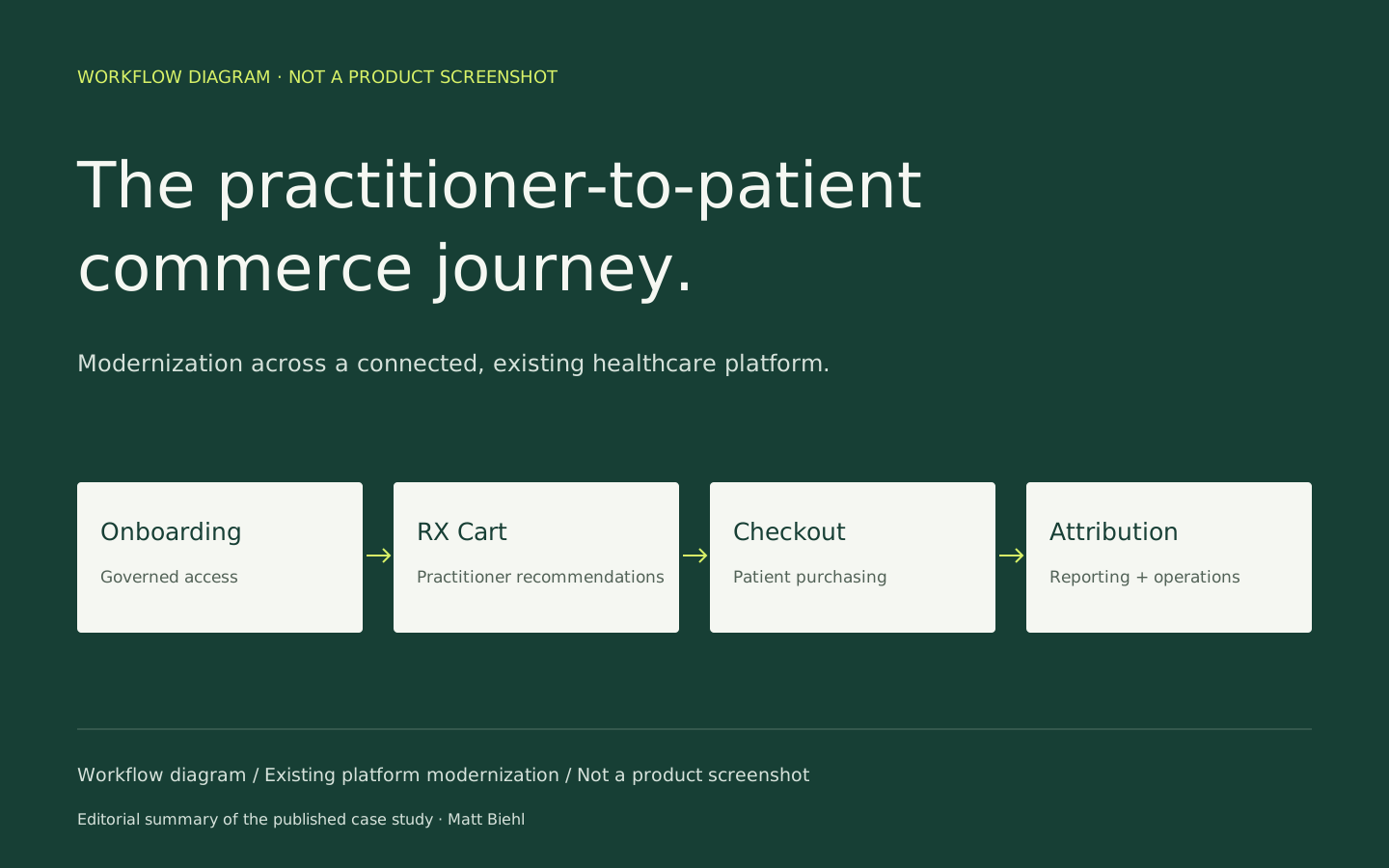
- Isolated RX Cart sessions while stashing and restoring ordinary ecommerce carts. Guest/self-pay users remain in Stripe; logged-in business users can enter account checkout. Standard, free-of-charge, and workers-comp flows follow distinct rules. The rx_source_cart_token links sessions, checkout, and orders.
- Redesigned registration as a guided flow supporting account/company branching, NPI lookup, healthcare-service requests, administrator-aware permissions, feature-specific versioned terms acceptance, and protected-page guards.
- Replaced reCAPTCHA with server-verified Cloudflare Turnstile and added Plausible registration-step instrumentation.
- Carried affiliate_id on individual Stripe products so one patient cart can retain multiple affiliate contexts.
- Added source-aware bundle URLs, separate QR/link engagement counters, unique bundle-user relationships, and idempotent tracking writes.
- Expanded RX reporting with filters, pagination, product-level rewards, conversion reporting, and traceability through bundles, orders, and items. Cancelled-order reconciliation changes unpaid rewards while preserving paid history.
- Shipped storefront landing experiences, reusable modal patterns, mobile improvements, cart/mini-cart regression fixes, and VSR surfaces moving category reads toward an API boundary.
Outcomes and limitations
Delivered more coherent practitioner-to-patient workflows, better cart isolation and attribution, governed onboarding, separately observable QR/link engagement, preserved reward auditability, and improved operational diagnosis. These are qualitative outcomes; the portfolio supplies no quantitative revenue or performance results. Legacy boundaries, external services, mixed account flows, and production regression risk remained constraints.
Adapted from portfolio text; images and navigation omitted.